


TLDR
The World Health Organization alerted global health officials to a hantavirus outbreak aboard a cruise ship in early May, encouraging precautionary measures to limit the spread of the disease.
Shortly following alerts about the outbreak, social media users across an array of alternative social platforms amplified baseless conspiracy theories alleging that health officials were stirring fear over hantavirus to disrupt 2026 US midterm elections.
Three days after these theories began to spread on alternative platforms, multiple high-profile conservative social media personalities amplified them to mainstream audiences.
Background
The World Health Organization issued alerts earlier this month stating that it was monitoring a hantavirus outbreak after three passengers died of respiratory illness aboard a Dutch cruise ship that departed from Argentina in April. Global health authorities assessed that hantavirus posed a low risk to the global population but advised nations to take precautionary measures to prevent its spread.1
As news spread about the outbreak, users across an array of social media sites spread speculative conspiracy theories and hyperbolic claims about hantavirus that echoed false narratives popularized during the COVID-19 pandemic.2 Many of these high-engagement conspiracy theories implicitly and explicitly alleged that hantavirus was a “plandemic” – a term popularized by a debunked video series that claimed the COVID-19 pandemic was orchestrated by global elites with sinister motives.3
Among the theories our researchers identified were claims that global health officials’ caution about hantavirus signaled the beginning of a plot to disrupt 2026 US midterm elections in ways that would harm Republican candidates. These theories were amplified on social media and various podcasts by a host of high-profile conservative personalities, including Benny Johnson and Tim Pool.4
Our Approach
Open Measures sought to understand where narratives linking May’s hantavirus outbreak to the 2026 US midterm elections originated and where they gained steam before later being amplified by high-profile figures.
Our researchers used our platform to identify posts that mentioned both terms associated with hantavirus and terms associated with midterm elections across alternative platforms we monitor including Telegram, Truth Social, Scored, and 4chan. We also searched Disqus, a networked platform used by websites and blogs to coordinate user comments. To surface potentially relevant posts, our researchers used the following search query:
(”hantavirus” OR “andes virus” OR “sin nombre virus” OR “hantaan virus” OR “seoul virus” OR “puumala virus” OR “ebola” OR “evd”) AND (“plandemic” OR election* OR voting OR midterm*)
We used our platform’s Discover feature to review the query results chronologically, to identify relevant narratives’ earliest appearances on alternative platforms. All searches were limited to April 30 and May 7, the one-week period prior to the day that high-profile conservative figures began amplifying narratives linking hantavirus to midterm elections.
Conspiracy Theorists Dub Hantavirus the ‘Midterm Virus’
Across an array of alternative platforms dominated by right-wing communities, Open Measures observed users beginning to circulate claims that global health authorities hoped to use hantavirus fears to disrupt 2026 US midterm elections almost immediately after the WHO published its May 3 alert about the cruise ship outbreak.
In our datasets, the earliest post we identified promoting this narrative was a May 3 comment on Scored, a platform that hosts a handful of pro-Trump forum boards:
World Health Organization (WHO) is supporting a public health event
Following an election virus (hantavirus) outbreak.
Within hours, a different user on Truth Social, a microblogging site owned by Trump, shared this post [sic]:
Hanti virus just in time to pave way for mail in ballots for midterms
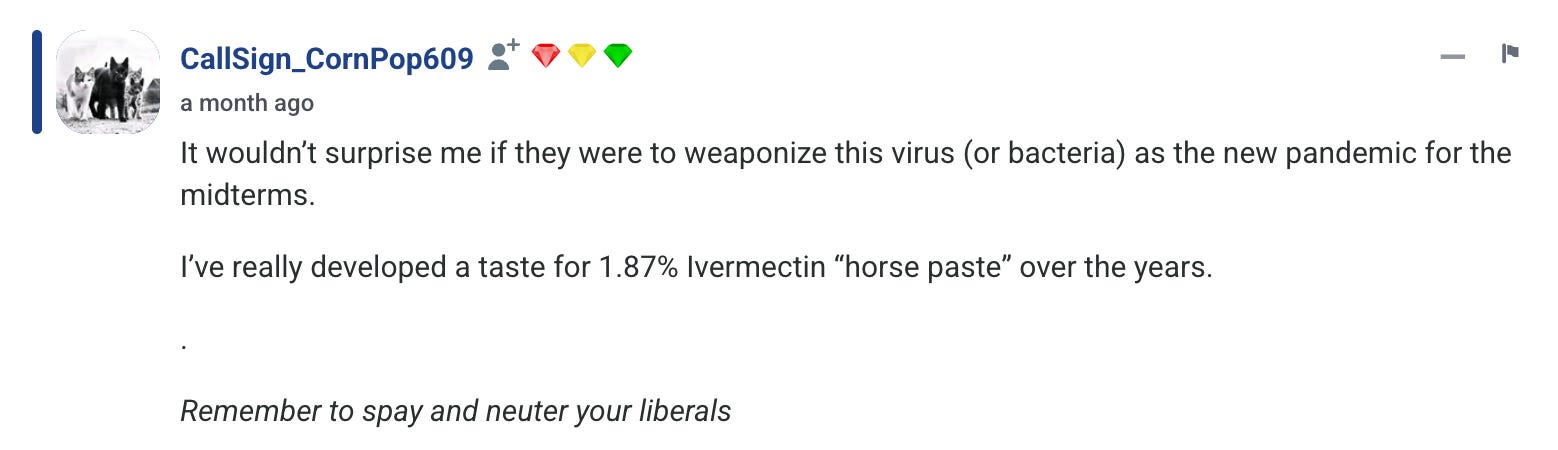
Later that day, a comment left on an article published by The Gateway Pundit, a hyperpartisan junk news blog, read:
It wouldn’t surprise me if they were to weaponize this virus (or bacteria) as the new pandemic for the midterms.
I’ve really developed a taste for 1.87% Ivermectin “horse paste” over the years.
Remember to spay and neuter your liberals
Expansion of Hantavirus Conspiracy Theories on Alternative Platforms
In hundreds of posts shared over a three-day period, various users spread the narrative further across alternative platforms. Researchers saw various users among these platforms refer to hantavirus as an “election virus” and the “midterm virus,” claiming that the infectious disease was “made up” to complicate voting in this year’s US midterm elections and “rig the election again.”
After iterating through conspiracist communities on alternative platforms, several high-profile social media personalities relayed them to larger audiences around May 7.
Our researchers also noted that, on alternative platforms, these conspiratorial narratives about hantavirus appeared alongside other posts espousing predictions that nefarious actors might leverage the disease to stir chaos in American society. In turn, these posts stirred even broader speculation, generating additional groundless discussion about which global elites might be involved and what their possible motivations might be.
Conclusion
Even as mainstream platforms loosen their content guidelines to allow more extreme content, Open Measures has previously observed that alternative platforms still function as originators and incubators for conspiratorial narratives and far-right talking points. In this case, our researchers identified high-profile conservative social media personalities amplifying baseless narratives that health officials’ hantavirus response was in some way connected to the 2026 US midterm elections – a narrative that had already been circulating on alternative platforms days earlier.
For researchers tracking the spread of harmful claims, monitoring alternative platforms can often provide early warning signals about which narratives are most likely to spread. As Election Day nears, Open Measures will continue to track conspiratorial narratives ahead of the 2026 midterms.
Identify online harms with the Open Measures platform.
Organizations use Open Measures every day to track trends related to networks of influence, coordinated harassment campaigns, and state- backed info ops. Click here to book a demo.
“Hantavirus cluster linked to cruise ship travel, Multi-country.” World Health Organization. 4 May 2026. Here.
Mike Rothschild. “2020 Was Nothing Compared to Our New Era of Public Health Conspiracy Theories.” Talking Points Memo. 23 May 2026. Here.