


TLDR
The United States and Israel conducted surprise airstrikes that killed dozens of Iranian government leaders on Feb. 28, initiating a war that has resulted in thousands of deaths across the Middle East. But beyond the battlefield, the war has also played out on social media, where state actors have sought to bolster support and shape public opinion.
Throughout the war, Iran’s military has repeatedly claimed to have targeted the USS Abraham Lincoln, a US aircraft carrier, in missile and drone strikes, resulting in severe damage to the ship. US Central Command has denied Iran’s claims.
State-backed media organizations and state-aligned aggregator channels on Telegram have boosted Iran’s claims about the USS Abraham Lincoln even after US officials denied them, stirring confusion and debate among English-speaking audiences on the platform.
Background
The United States and Israel carried out surprise military strikes against Iran on Feb. 28 that killed dozens of top Iranian government officials – including its head of state, Supreme Leader Ali Khamenei – and initiated a war that has since resulted in thousands of deaths and severely disrupted global trade.1 At the time of writing, attempts to negotiate a peace deal between the US and Iran have been strained.2
Beyond the battlefield, the war is also being fought on social media platforms, where warring countries and their allies have sought to rally support and shape public opinion. US and Israeli state officials have used social media to threaten and criticize Iranian leaders.3 Iranian state actors, alongside allied operatives in Russia and China, have reportedly intensified their longtime efforts to influence online political discourse among Western audiences.4
As we’ve previously reported on other conflicts, state and state-aligned actors have taken steps to manipulate the flow of information during escalations in the war in Iran, polluting the environment with false and misleading claims and creating obstacles for open-source researchers. As an additional complication, some false or disputed claims have been supported by inauthentic photos and videos produced with generative AI software.5 Some researchers have alleged that operatives aligned with Iran’s government were responsible for the majority of AI-generated fakes spread during the war, but Open Measures was unable to independently corroborate those claims.6
On Mar. 15, US President Donald Trump shared a post on Truth Social that described Iran’s reported use of AI-generated content on social media as amounting to a “Disinformation weapon,” arguing that news media organizations “should be brought up on Charges for TREASON” for sharing AI-generated material from Iran.7
Reported Attacks Against US Aircraft Carrier Stir Confusion
The Islamic Revolutionary Guard Corps (IRGC), Iran’s primary military force, has repeatedly targeted US warships deployed in the region with missiles and drones since the war began. Many of its attempted attacks have targeted the USS Abraham Lincoln, a US aircraft carrier supporting airstrike operations against Iran.
On several occasions, the IRGC claimed its strikes on the USS Abraham Lincoln inflicted significant damage on the ship that forced it to flee the region. US Central Command (CENTCOM) has repeatedly denied those claims and stated that the ship remains fully operational.8 But despite US rebuttals, Iranian officials have continued to declare that their operations aimed at the ship have been successful – with newer claims sometimes in direct conflict with their own prior claims.
Amidst contradictory statements from government officials, fact-checkers and researchers observed AI-generated videos circulating on social media that purported to show the USS Abraham Lincoln taking on major damage from Iran’s reported strikes.9 On Mar. 16, Trump told reporters that after seeing one such video, he asked a US military general about the ship’s status, only then learning that the video was fake.10
State-Backed Media Shared IRGC Claims, State-Aligned Aggregators Spread Them Further
Open Measures sought to better understand the role that state-backed media outlets and state-aligned actors played in promoting disputed claims about Iran’s attacks on the USS Abraham Lincoln among English-language audiences. For our analysis, researchers examined how state-affiliated actors boosted the IRGC’s claims on Telegram: a cloud-based messaging app used by billions around the globe.11
Using our platform’s Timeline feature, we analyzed the daily post volume of four English-language, Iranian-government-backed news outlets on Telegram – Mehr News Agency, Tehran Times, Press TV, and the Islamic Republic News Agency (IRNA) – and found that all four began to post more frequently after the war began.
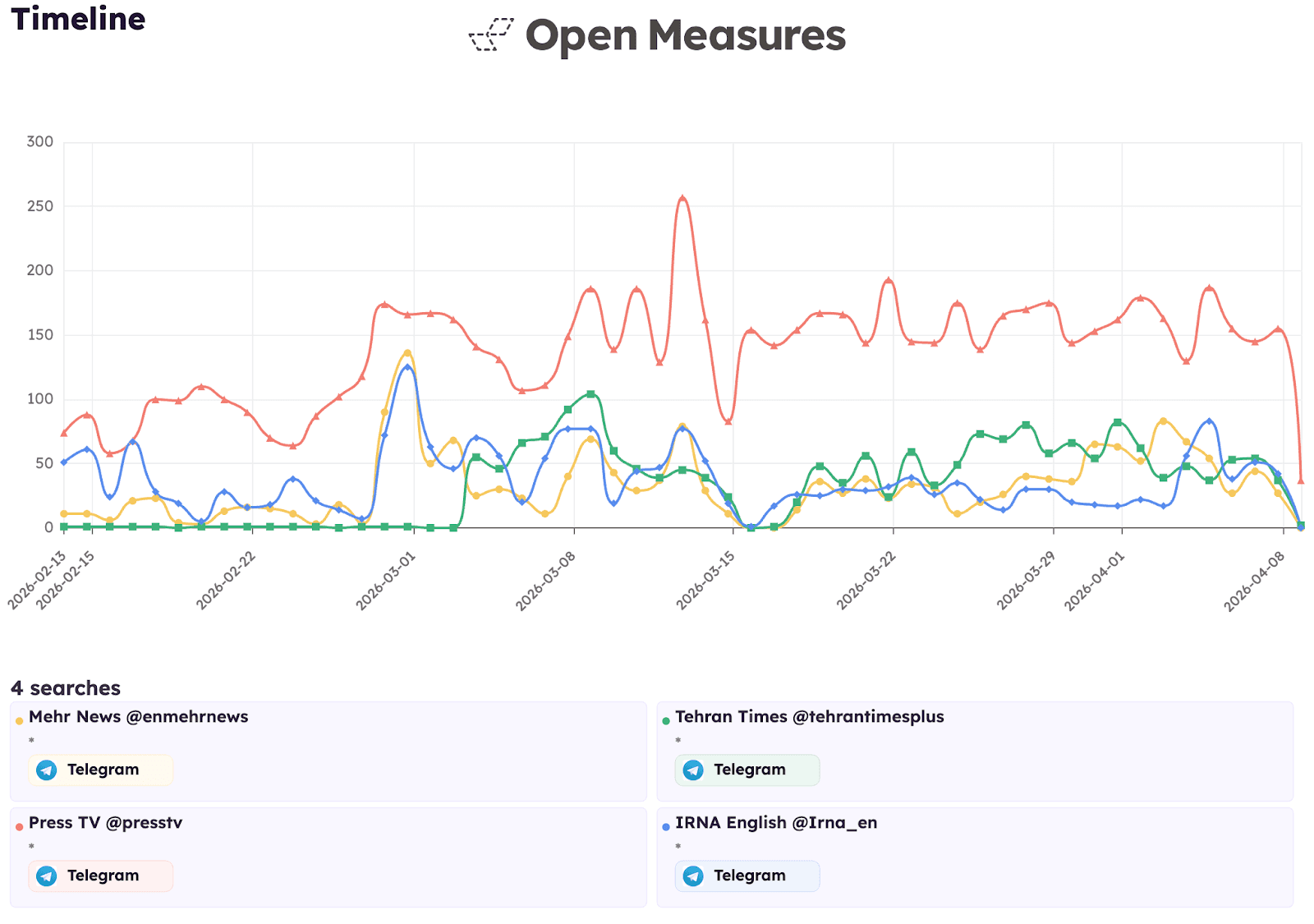
To identify Telegram posts discussing Iran’s attacks on the USS Abraham Lincoln in our datasets, researchers used the following search query:
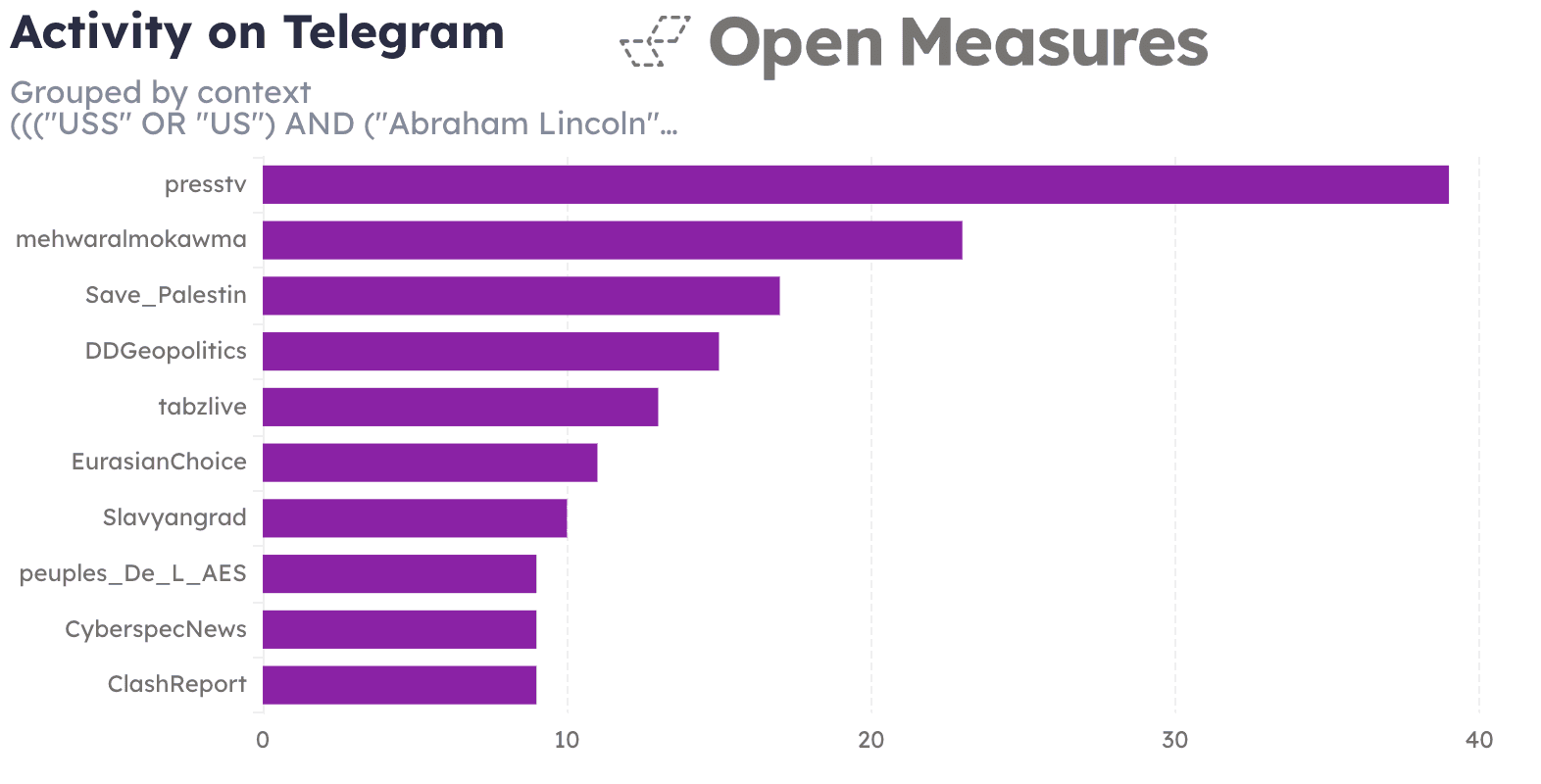
((("USS" OR "US") AND ("Abraham Lincoln" OR "Lincoln")) NOT ("Gerald R. Ford" OR "Gerald Ford" OR "Tripoli" OR "Bataan" OR "Carter Hall")) AND (missile* OR drone* OR attack* OR fire* OR damage* OR strike* OR struck OR sank OR sunk OR flee* OR fled OR retreat*)The query identified 564 total Telegram posts shared across 172 unique channels between Feb. 28 and April 14. According to our data, those posts cumulatively received nearly 3.5 million views and were together re-shared more than 19,000 times.
Using our platform’s Activity feature, we saw the highest number of posts matching our query in a Telegram channel operated by Press TV, an English-language outlet operated by Iran’s government. Since the war began, 38 posts in the channel mentioned attacks on the USS Abraham Lincoln. In total, the 38 posts identified were re-shared at least 645 times and received nearly 165,000 views.
Other channels that had frequently shared posts we identified included state-backed news outlets in Russia and dozens of aggregator channels that promote news reports and messaging aligned with Iran and its allies, including Russia, Turkey and Palestine.
Case Study
Open Measures found that Iranian and Russian state-affiliated media organizations played critical roles in spreading the IRGC’s claims about attacking the USS Abraham Lincoln on Telegram. Throughout the war, the outlets shared English-language posts amplifying statements made by IRGC officials, which were then shared and cited by a host of state-aligned news aggregation channels. As the claims gained traction, they spread to groups with broader political orientations, spurring debate and confusion – a key objective of past misinformation campaigns.12
Our researchers looked closer at the posts our query identified between Mar. 12 and Mar. 16, after the IRGC claimed its attacks against the USS Abraham Lincoln had been severe enough to render the ship “inoperable” and force it to retreat to the US. CENTCOM denied the claims, calling them “recycled lies,” and stated that the ship was still in use.13
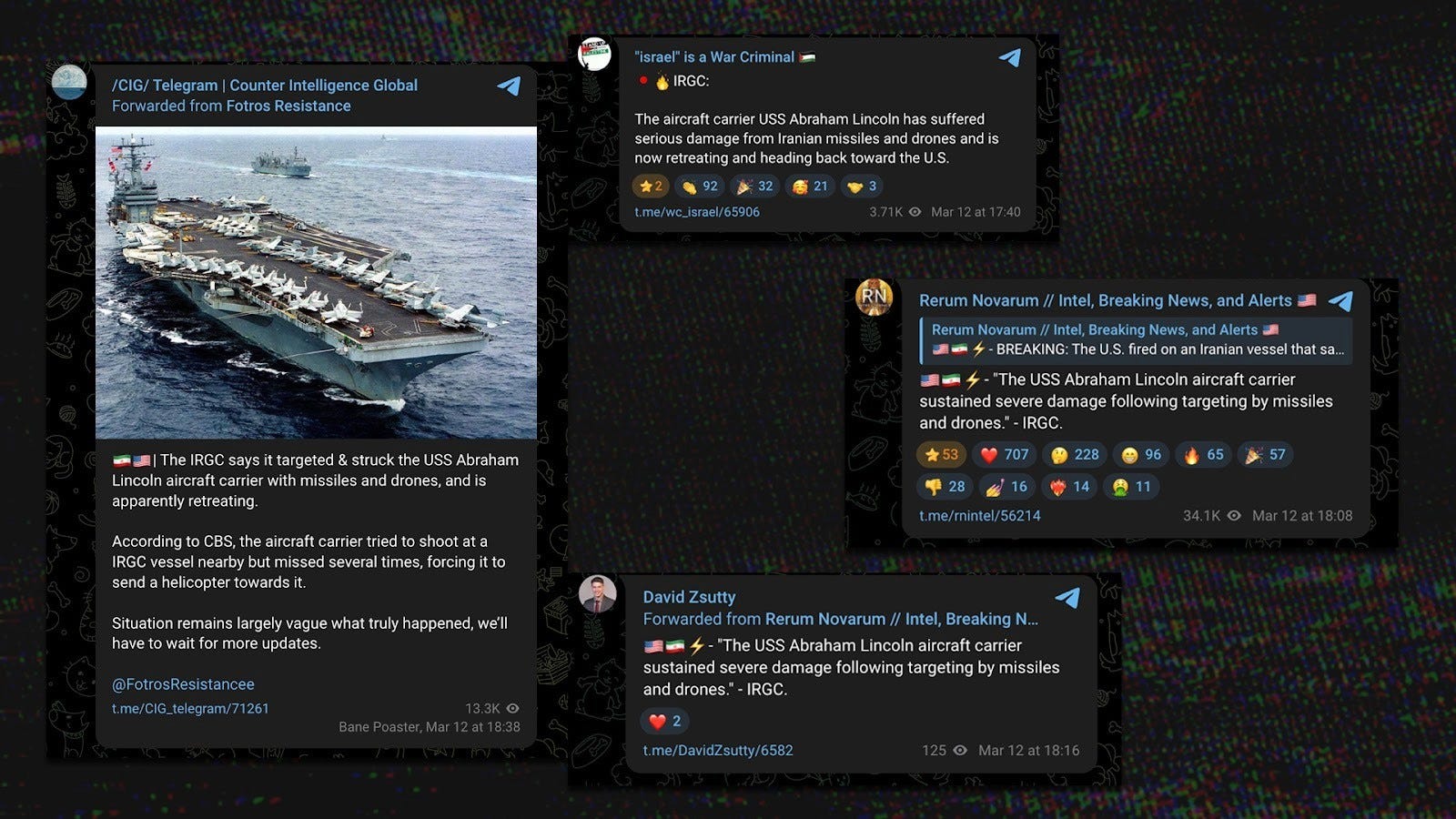
On Mar. 12, a host of state-aligned aggregator channels shared posts promoting IRGC claims that the USS Abraham Lincoln had suffered major damage and was retreating back to the United States.
During this period, we identified 108 posts from our query that together received more than a quarter-million views and 6,400 re-shares. Some results were false positives, sharing reports that US forces fired on an Iranian vessel that got too close to the ship.14 Researchers excluded those posts from the following analysis.
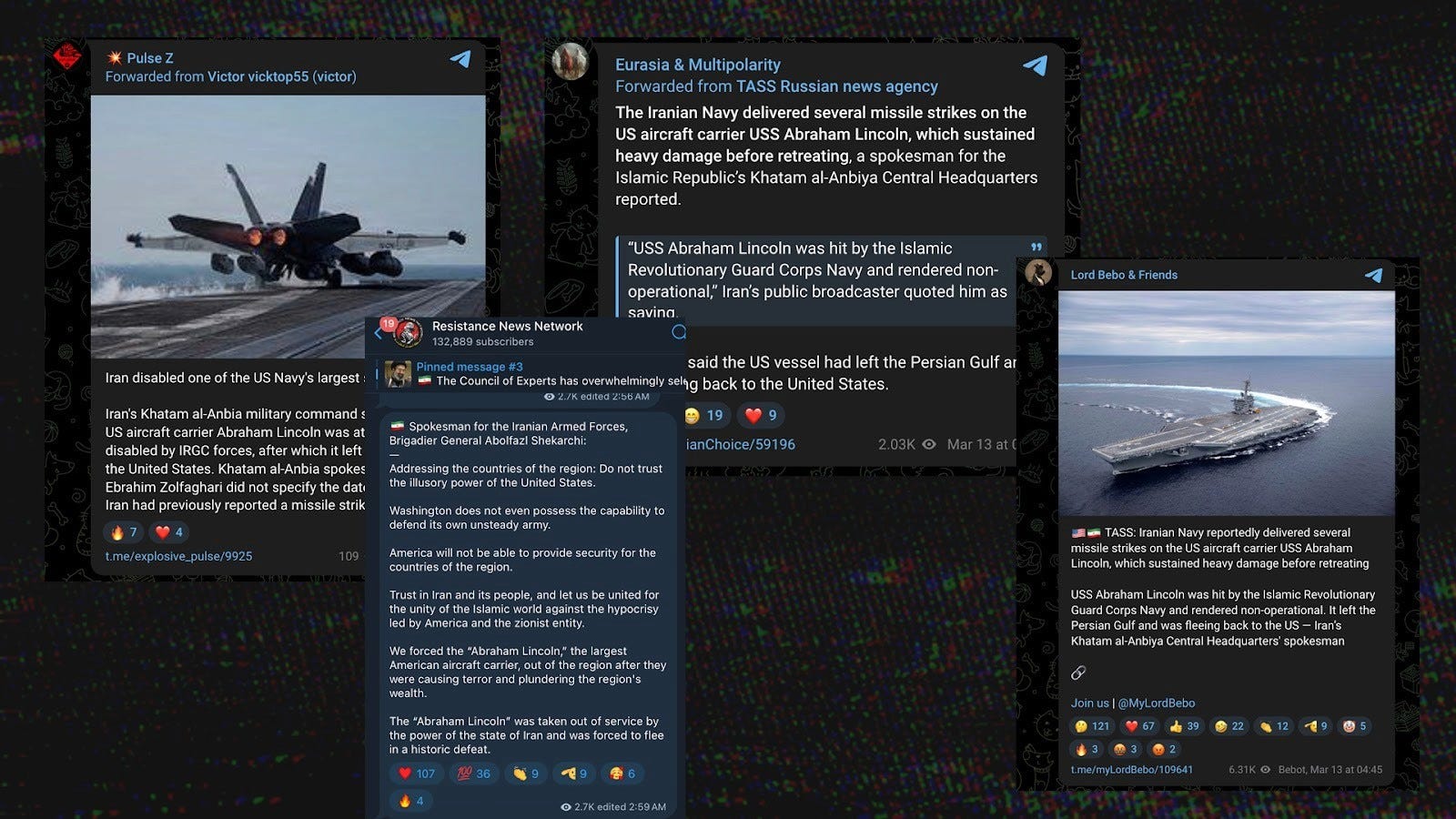
In the hours that followed, Iranian and Russian state-backed media organizations shared posts containing the same claims, but packaged as news reports.
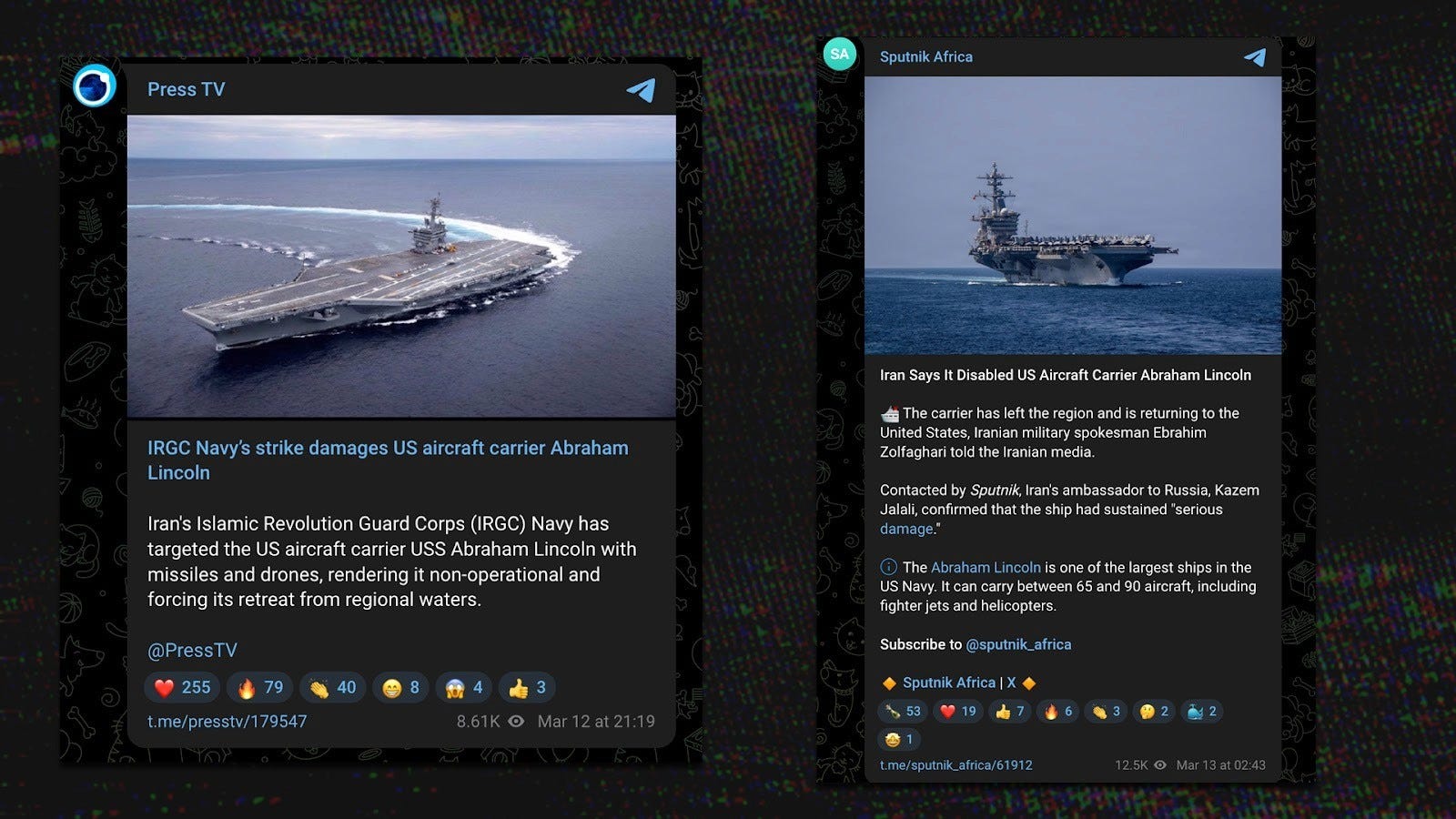
As the story developed, more news aggregation accounts shared the claims, sometimes sharing or attributing directly to Iranian and Russian state-backed media organizations. As the story developed, this circular process repeated several times.
After CENTCOM denied the IRGC’s reports about the attack and Trump denounced Iran’s alleged use of AI-generated misinformation, state-backed outlets and state-aligned aggregators responded by recirculating the IRGC’s claims the ship was severely damaged in its attacks and forced to retreat from the region, reposting and citing prior reports from aggregators and state-backed outlets.
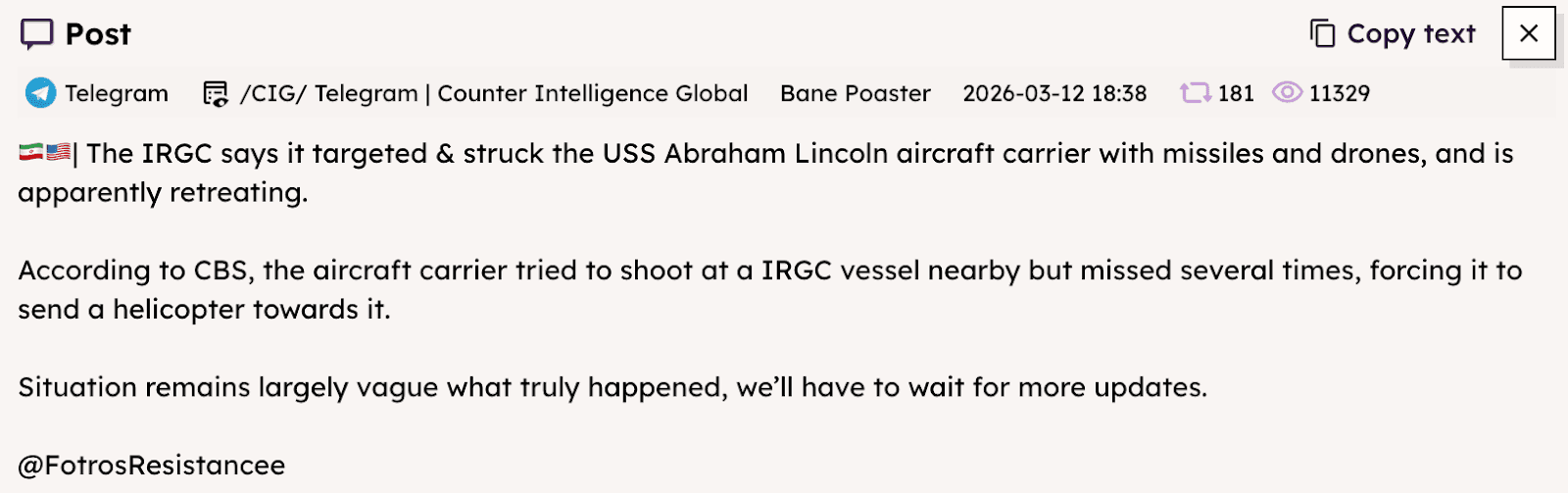
The conflicting claims spurred doubt among some online communities, who questioned what had actually happened to the ship. For example, on Mar. 12, a post in a Telegram aggregator account questioned “what truly happened.”
Conclusion
The rise of open-source intelligence research and social media analysis in recent decades has caused global conflicts to receive unprecedented scrutiny from their onlookers. Our analysis suggests that state-backed media organizations and state-aligned aggregator accounts are cognizant of this fact and may be seeking to complicate online analysis of the Iran war (in addition to other objectives, like rallying public support, or creating confusion and political unrest among the citizens of an opposing country).
As seen in the case of the USS Abraham Lincoln, state-backed actors play a critical role in stirring confusion over reported events but are rarely the sole drivers of information disorder surrounding international conflicts. Rather, they seed the ecosystem with the source material state-aligned actors need to spin up their own narratives. Advancements in generative AI technology have exacerbated the issue, making it easier than ever to create fake images and videos as “evidence” for false narratives.
Open Measures builds research tools to help researchers stay afloat in this ever-evolving social media landscape.
Identify online harms with the Open Measures platform.
Organizations use Open Measures every day to track trends related to networks of influence, coordinated harassment campaigns, and state-backed info ops. Click here to book a demo.
Lynsey Chutel and Shawna Richer. “What to Know About the U.S. Attacks on Iran.” The New York Times. 28 Feb. 2026. Here.
David E. Sanger, Tyler Pager, and Farnaz Fassihi. “U.S. Is Negotiating an Iran Deal That Would Buy Time, Again.” The New York Times. 13 April 2026. Here.
Edward Wong. “Trump Revels in Threats to Commit War Crimes in Iran.” The New York Times. 5 April 2026. Here.
Steven Lee Myers, Tiffany Hsu, and Stuart A. Thompson. “In an Asymmetrical War, Iran Seeks an Edge With Its Information War.” The New York Times. 28 March 2026. Here.
Thomas Copeland. “AI-generated Iran war videos surge as creators use new tech to cash in.” BBC News. 6 March 2026. Here.
Leah Siskind and Marina Chernin. “Deepfakes on the Front Lines: Iran’s AI Disinformation Campaign.” The Foundation for Defense of Democracies. 19 March 2026. Here.
Kenrick Cai. “Trump accuses Iran of using AI to spread disinformation.” Reuters. 15 March 2026. Here.
Lara Seligman. “Centcom Rebuts Iran Claim It Struck Lincoln Aircraft Carrier.” The Wall Street Journal. 1 March 2026. Here.
Jeff Li. “AI-generated clip and old video shared in false posts about Iran striking USS Abraham Lincoln.” AFP. 11 March 2026. Here.
Mark Stone. “Trump fooled by fake AI video - and three other takeaways from his latest appearances.” Sky News. 17 March 2026. Here.
Ivan Mehta. “Telegram founder Pavel Durov says app now has 1B users, calls WhatsApp a ‘cheap, watered down imitation’.” TechCrunch. 19 March 2025. Here.