


TLDR
Conservative political figures and media outlets have spent the summer attacking the WNBA with an array of longstanding “culture war” narratives, driving increased reports of hate and harassment against players. Open Measures examined how anti-WNBA narratives have evolved in right-wing communities in recent months.
The WNBA has seen unprecedented growth in recent years, credited in large part to fans’ excitement for rising star players like Indiana Fever guard Caitlin Clark and Atlanta Dream forward Angel Reese. In 2025, the WNBA drew record-breaking attendance and television viewership, the highest that professional women’s basketball has seen in the United States since the league’s inception.
But the WNBA’s growth has also come at a cost to its players, who have reported being increasingly targeted by online commenters’ bigoted hate, personal harassment, and violent threats. The problem has grown so severe that the WNBA launched a dedicated task force meant to address the issue, which has implemented new security protocols, online threat-monitoring programs, and mental health resources for teams and players.
WNBA officials and many top players, like Clark, have repeatedly condemned threats made against members of their league, and have publicly denounced those who have sought to hijack public conversation to promote hateful and demeaning rhetoric. But those remarks have done little to quiet toxic commentary, which has devolved into a “rinse-and-repeat drama” over the summer.
Hyperpartisan News Blogs Drive Divisive Rhetoric Around WNBA
Conservative political figures have intensified their focus on the WNBA this summer, leveraging drama in the league to promote their movements’ longstanding and divisive “culture war” narratives targeting minority groups. Since June, largely egged on by hyperpartisan media, their rhetoric has grown more aggressive and earned buy-in from Republican lawmakers.
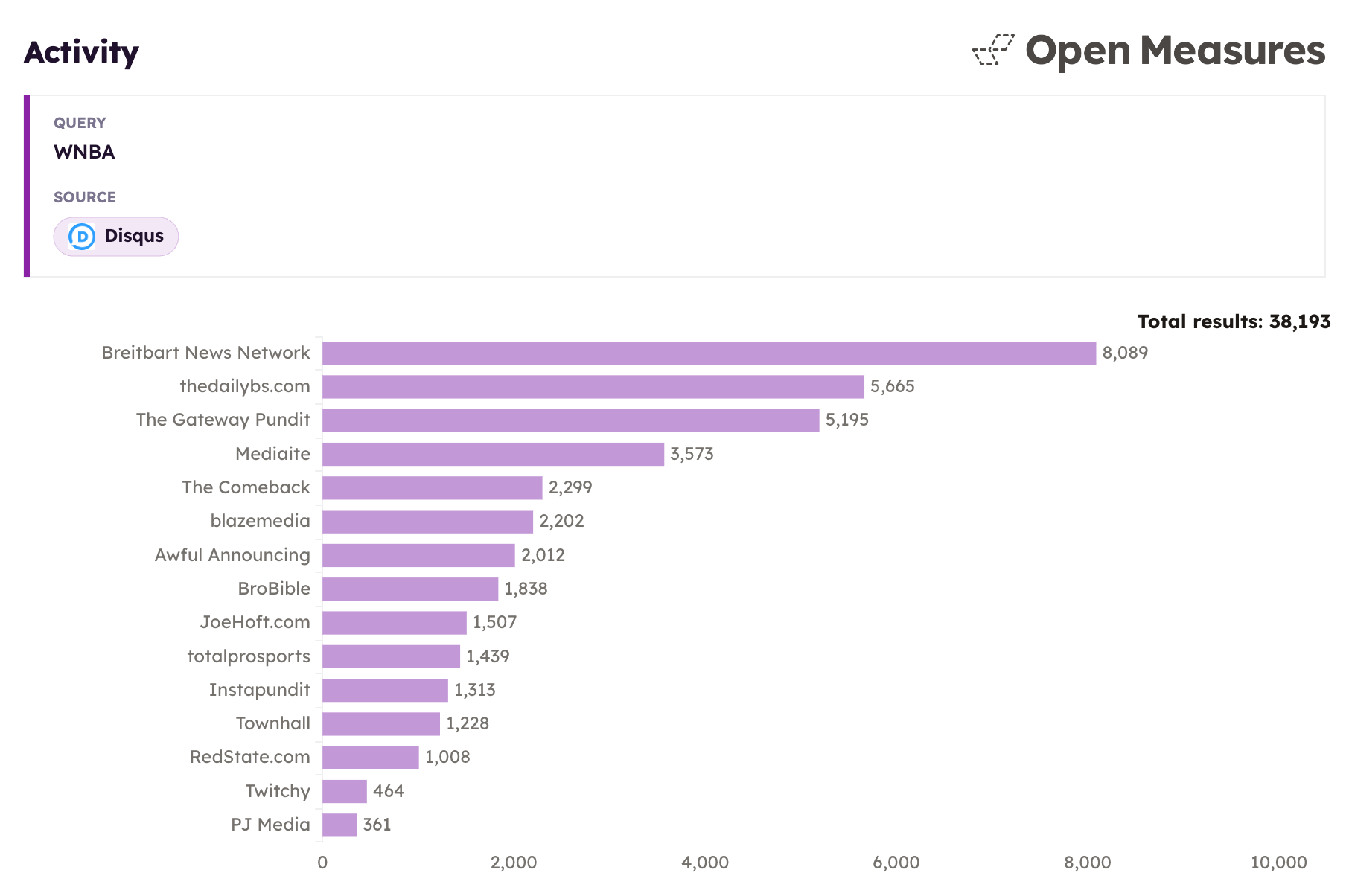
We used our platform’s Timeline tool to search for posts mentioning the WNBA across nine platforms dominated by right-wing political communities since May 24, finding that the daily volume of posts we identified per day drastically increased throughout the summer.
Between May 24 and Aug. 24, users on those nine platforms shared more than 14,000 posts mentioning the league. Over the three-month period we analyzed:
May 24 to June 24: 536 posts (~4% of total posts)
June 25 to July 24: 3,446 posts (~24% of total posts)
July 25 to Aug. 24: 10,125 posts (~72% of total posts)
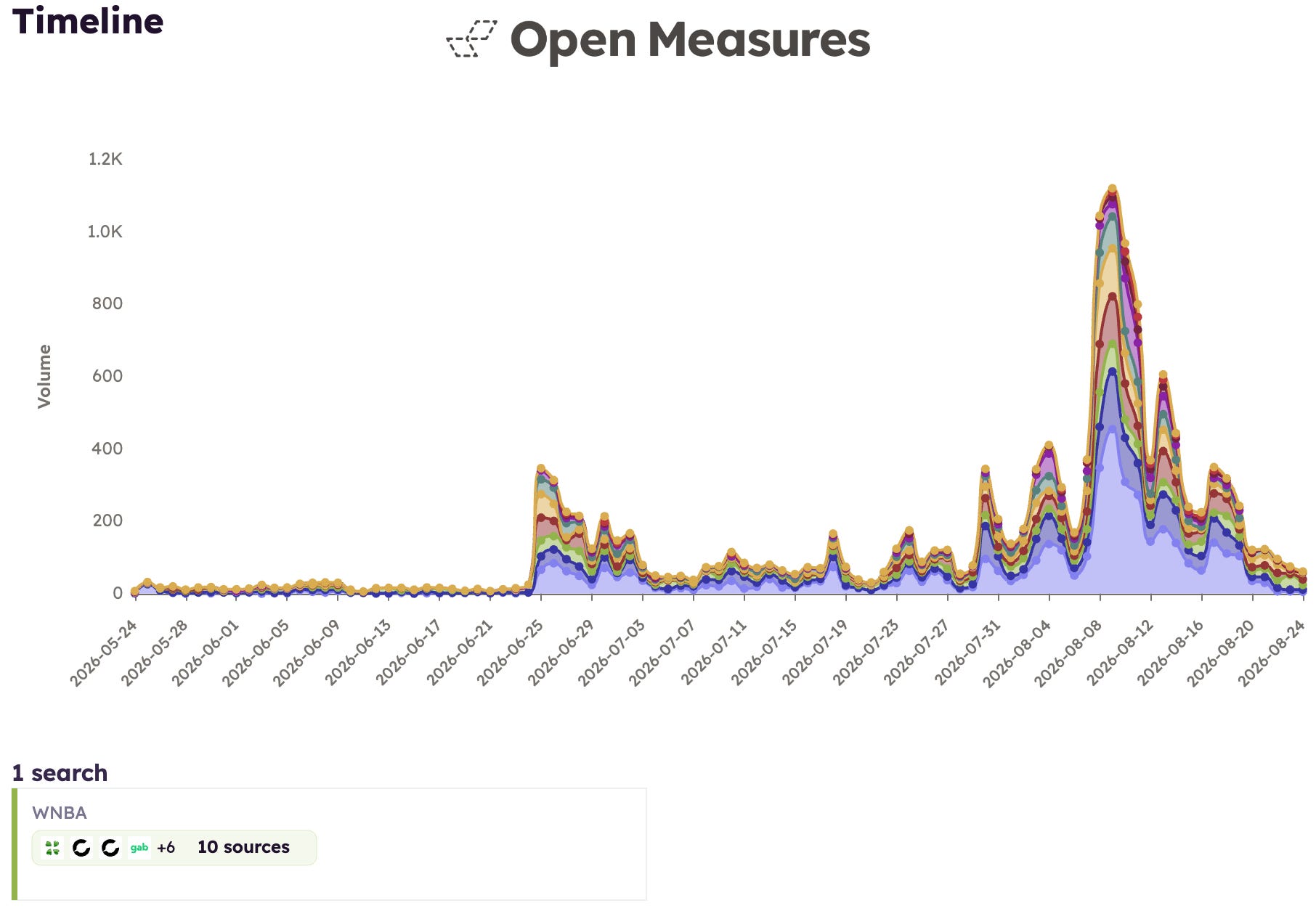
We identified a similar trend in the number of comments shared to websites that use Disqus, the web’s most-popular third party commenting and discussion platform. Between May 24 and Aug. 24, more than 46,000 comments on Disqus-enabled sites mentioned the WNBA.
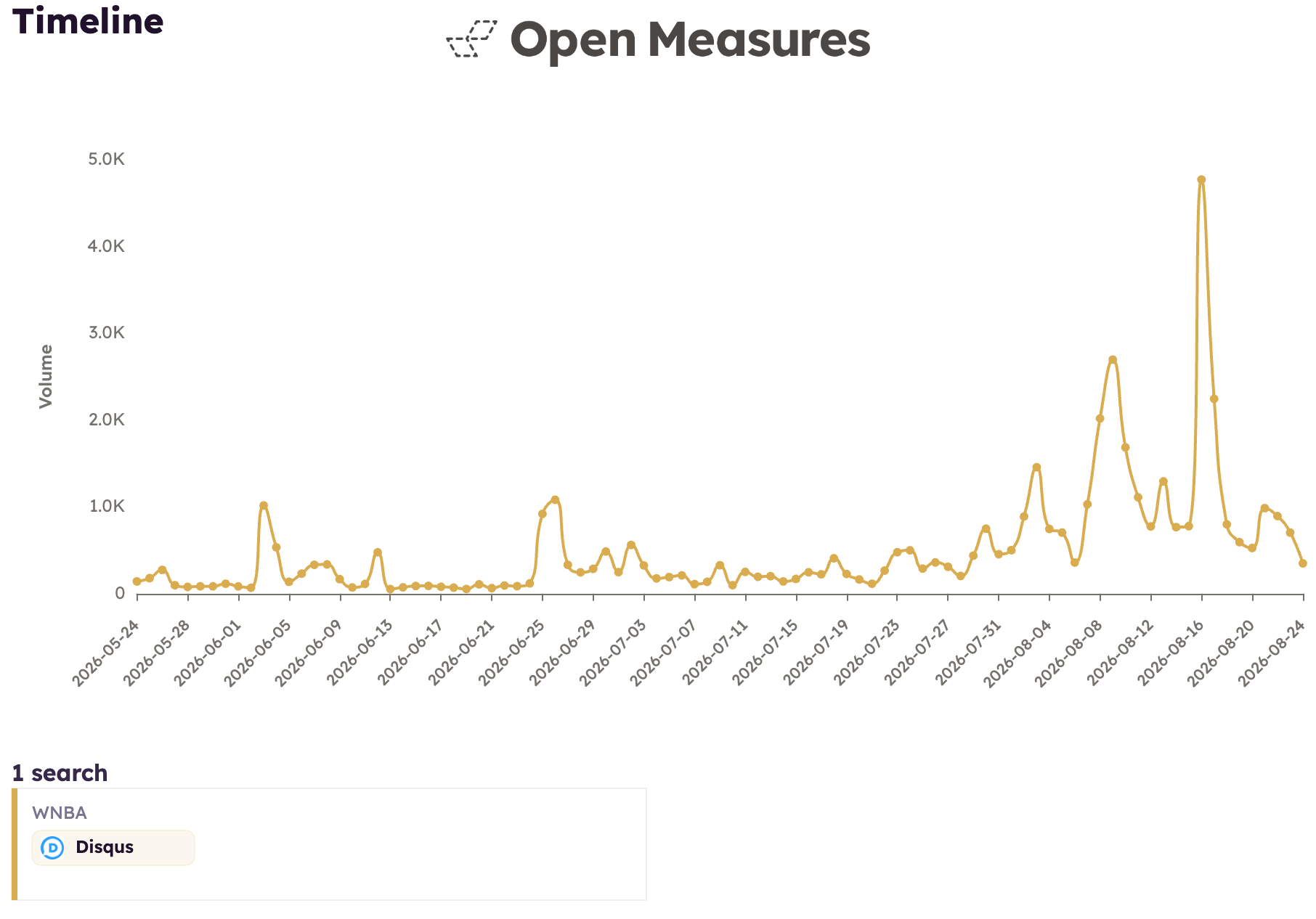
Using our platform’s Activity tool, we found that the vast majority of Disqus comments mentioning the WNBA during our analysis period were shared on right-wing political news blogs, which ran a slew of inflammatory stories about the league this summer.
Of the 15 sites where the highest volumes of Disqus comments mentioning the WNBA appeared, 10 were hyperpartisan political news blogs. Together, those 10 publishers saw more than 27,000 comments – more than 58% of all Disqus comments we identified.
Initial Narratives Targeting WNBA Alleged Anti-White Racism
As seen in the Timeline chart above, discussion of the WNBA across platforms that harbor right-wing political communities began to surge in late June, as hyperpartisan media outlets ran stories highlighting fouls that Black WNBA players committed against Clark, who is white, and allegations that referees were calling a disproportionate number of fouls against Clark during games. Political actors cited those stories to fuel narratives suggesting the WNBA was racist against white people and that Clark was being targeted on the court on the basis of her race.
Those narratives surged through right-wing communities after June 25, when Phoenix Mercury forward Alyssa Thomas made contact with Clark’s throat during a game. The collision, which Thomas called a “complete accident,” was subsequently upgraded to a Flagrant Foul 2 penalty and resulted in a one-game suspension for Thomas.
In the following days on the platforms we analyzed, we identified thousands of users sharing disparaging remarks about the WNBA, Thomas, and referees. Using Research Assistant to summarize dominant themes across more than 5,500 posts in the week after the foul occurred, we found that the dominant narratives that emerged from the incident centered on racial grievances and prejudices against LGBTQ+ people.
Example posts promoting these narratives include a June 27 post from right-wing radio host Wayne Allyn Root on Truth Social:
Wow is there anti white hate and racism in WNBA. These black ladies hate a white lady superstar. They openly beat the crap out of her in front of tv cameras- and her teammates do nothing. Because she is white. This is allowed in America? Disgusting!
A June 25 comment shared on an article on the right-wing news outlet Townhall, via Disqus:
Black lesbians are black first, violent second and so rabidly racist, they cannot embrace or accept the only positive, real basketball player to hit the WNBA. Now, the WNBA has been exposed for what it is, a racist schoolyard brawl, where the blacks throw punches and elbows every chance they get, hoping to get rid of the white girl. Talk about a problem race, who has exhibited 27 years of failure on their own, and are trying to regain their failure these past two years by destroying Caitlin Clark.
And a June 25 comment shared on an article from the far-right news outlet Breitbart News, via Disqus:
The WNBA commissioner, an lgbt, has told head coaches to have goons on their teams harass and foul Clark incessantly, and try to injure her.
Then the commissioner laid an edict to the refs. to look away, don’t call it, LIE that they didn’t see it.
[...]
The league is made up of YES it’s true...men(trans players), lgbt and low IQ women.
They can’t have a straight white christian girl playing at a high level and is THE MOST popular player in the league.
Weeks later, a group of 11 GOP lawmakers sent a letter to the WNBA expressing concern that fouls against Clark – which they described as “attacks” – were “racially motivated,” adding that the league’s failure to protect Clark may have violated federal civil rights laws.
After fouling Clark, Thomas said she received death threats and was accosted with racial slurs; she also criticized WNBA commissioner Cathy Engelbert for not doing more to address threats players receive. Indiana Fever coach Stephanie White called the abuse hurled at Thomas “absolutely unacceptable,” adding that she believed most of the toxicity surrounding the WNBA wasn’t coming from its fans, but rather from online communities pushing “divisive, hateful narratives.”
Sophie Cunningham’s Anti-Transgender Comments Ignited Weeks of Partisan ‘Culture War’ Attacks on WNBA
Racialized commentary surrounding Clark and the WNBA persisted in right-wing media for weeks after the June 25 foul that set it off. Then, in late-July, one of Clark’s Indiana Fever teammates thrust the league into the crosshairs of contemporary right-wing media’s most excitable culture wars: transgender athletes competing in women’s sports.
On July 21, ESPN published a lengthy profile of Indiana Fever guard Sophie Cunningham, which quoted her voiced opposition to allowing transgender athletes to compete in women’s sports. Cunningham explained she wanted to “protect young girls in a locker room, or young girls in sport who shouldn’t have to go against biological men.”
Cunningham’s remarks, which echoed false anti-LGBTQ+ movement talking points that seek to portray transgender people as sexual predators who target children, elicited anger across the WNBA – a league that currently has no transgender players. Her comments, and their negative reactions, dragged the WNBA into the crosshairs of right-wing media’s longstanding anti-LGBTQ+ “outrage machine.”
Conservative political activists rallied to support Cunningham as she drew pushback from WNBA colleagues and the league’s fans. The Trump Administration lauded her in social media posts and public statements, anti-transgender activists like Riley Gaines appeared at Indiana Fever games, and former NBA players Enes Kanter Freedom and Royce White cynically declared they were women and would be submitting themselves for the 2027 WNBA draft.
Across the platforms we analyzed, right-wing communities lauded Cunningham as a heroic figure, and framed criticism of her comments as attacks on “truth.” In subsequent weeks, we also saw those communities incorporate Cunningham into their prior narratives alleging the WNBA was racist against white people, following fouls that the league’s Black players committed against Cunningham during games. Other prominent narratives disparaged Cunningham’s critics, praised right-wing activists who rallied to support her at games, and hyped the former NBA players who declared they were women who wanted to play in the WNBA.
The highest volume of posts related to Cunningham’s remarks surrounded an Aug. 12 meeting where a WNBA task force met to discuss the increased hate and harassment plaguing the league since it became an unwilling focal point in right-wing political commentary disparaging transgender people. Conservative social media personalities falsely claimed the meeting was meant to determine “what a woman is” and lambasted the league when it did not issue a statement along those lines.
Then, in mid-August, the r/WNBA subreddit banned new posts about Cunningham that were unrelated to basketball and filtered out new posts from users who had not been active in the community before. In an Aug. 16 post, moderators explained the rules were in place [sic] “so the subreddit will not be over-ran with trolls or brigaded.” Across several alternative platforms, right-wing communities cited the decision as proof of the league’s supposed political bias and framed it as a censorship issue.
Over the most recent month of our analysis period, we saw that right-wing news outlets and the communities that read them latched on to an array of inflammatory narratives surrounding the WNBA and transgender athletes, keeping the narrative active for several weeks. At the time of writing, anti-WNBA narratives are still circulating in hyperpartisan media and online communities – with more staying power than many outrage cycles we’ve previously analyzed.
WNBA Express Frustration with WNBA’s Response to Attacks
As the WNBA has attempted to respond to the months-long outrage campaign targeting the league this summer, users on platforms that harbor large left-wing political communities criticized its handling of the situation.
Some of the criticisms faulted WNBA commissioner Engelbert, as seen in this July 30 post on BlueSky:
If we’re talking about this moment in America where so many supposed-leaders (organizational, electoral, cultural, etc.) have failed to rise to the occasion, we shouldn’t just focus our ire on politicians!
Cathy Engelbert is a consultant masquerading as a commissioner.
Other users faulted the league for what they perceived as efforts to pacify its right-wing critics, as seen in this Aug. 8 post on Bluesky:
Pretty wild that the WNBA is deciding apparently to squander all the good will it built with the community who has spent an obscene amount of money on tickets and merch and formed the base of their success. Even if you don’t give a fuck about human rights (🫠), this is just a bad business decision!!!
We also saw hundreds of posts from Bluesky users who expressed resentment that the WNBA was being forced to deal with these sorts of controversies to begin with. A Sept. 30 post from a Bluesky user who said they were a fan of the league read:
Been a fan of the WNBA for years, and what the racists and homophobic/anti-trans bigots have done to the league and the attention it gets the last three years is so fucked. They are trying to steal our fun and fuck them all for it.
And an Aug. 14 post on Bluesky read:
I HATE it when people say “the culture wars” or “the discourse” are ruining the WNBA. BE PRECISE. Right-wing fascists are introducing misogyny and bigotry through their narratives and demands, in an effort to delegitimize an organization full of popular black women who vocally champion inclusivity.
Our Take
Women’s professional sports are experiencing a global surge, attracting new audiences, opportunities, and resources for teams and athletes. But that growth has also elicited previously unseen amounts of online hate and harassment against players, who typically have fewer resources available to detect and mitigate threats than men’s sports teams do.
Much of the controversy surrounding the WNBA this summer has revolved around longstanding “culture war” tropes employed by right-wing media and political figures to disparage minority groups, and that rhetoric has predictably elicited torrents of online hate against its players. And while the WNBA and its biggest stars have attempted to distance themselves from bad-faith critics, Cunningham’s anti-transgender comments effectively dissolved whatever barrier separated them.
Online threats against athletes – particularly women, racial minorities, and LGBTQ+ players – are a growing issue in professional sports. Open Measures’ platform is designed to assist monitoring and analysis across dozens of alternative platforms where online harms can arise, and our team will continue to monitor for threats as the landscape evolves.