

TLDR
A lawsuit filed by a former Campbell’s Soup Company employee last month claimed the company fired him after he reported alleged comments made by Martin Bally, the company’s then-vice president of information technology, to internal management.
In the lawsuit claimed Bally made racist comments about employees and disparaged Campbell’s products and customers, claiming the company’s products were made with “bioengineered meat” and were made for “poor people.”
Bally’s alleged comments sparked outrage and discussion among users of five microblogging sites the week of Thanksgiving, with some users claiming they would no longer purchase Campbell’s products. Other users and online conspiracy theorists left posts championing Bally as a whistleblower (gaining significantly more engagement than other posts criticizing Campbell’s more generally).
On Nov. 26, Campbell’s released a statement denouncing Bally’s alleged comments, categorically denying any claims that their food contained subpar ingredients, and stating that Bally was no longer employed by Campbell’s.
Background
On Nov. 18, a former employee filed a wrongful termination lawsuit against Campbell’s Soup Company, alleging that he’d been fired for reporting offensive comments made by Martin Bally, Campbell’s then-vice president of information technology, to his manager.
The lawsuit claimed Bally had made racist remarks about the company’s Indian employees and disparaged the company’s products as allegedly containing “bioengineered meat” fit only for “poor people.” Following news media coverage of the lawsuit, Campbell’s fired Bally, denounced his alleged comments, and categorically denied that their products contained any questionable ingredients.1
Bally’s alleged comments created online outrage as they became public, generating a range of opinions both supportive and critical of Bally and of Campbell’s. To assess how these narratives developed, Open Measures investigated the conversation on five microblogging platforms we monitor: Bluesky, Gab, Fediverse, Telegram, and Truth Social.
Methodology
To identify relevant posts discussing both Campbell’s and Bally, our researchers searched for posts made between Nov. 18 and Dec. 2 (the two weeks after the wrongful termination suit was filed) using the following search string:
“martin bally” OR “campbell’s soup” OR “campbells soup”
From the initial results returned by the string above, our researchers developed additional strings to target and quantify specific, repeated themes they observed in surfaced posts, as detailed below:
Negative Discussions of Product Quality:
fake OR bio-engineer* OR bioengineer* OR junk* OR disgust* OR frankenfood* OR lab-grown* OR print* OR 3d-print* OR clone* OR crap* OR suspect* OR unhealthy OR garbage OR inedible OR toxic OR gross
Discussion Related to Economic Class:
“the poors” OR “the poor” OR rich* OR millionaire* OR billionaire* OR wealth* OR income* OR “poor people” OR elite*
Discussion Related to Alleged Racist Comments:
racis* OR indian* OR bigot* OR hate*
Discussion Related to Negative Consumer Actions:
boycott* OR “never eating” OR “don’t need” OR “won’t get” OR “throwing out” OR “don’t buy” OR reconsider* OR “no more” OR “quit buying” OR “not be buying” OR “stop buying” OR dump* OR “fuck campbell’s soup” OR avoid* OR toss* OR “done buying” OR “never buy” OR “never buying”
Analysis
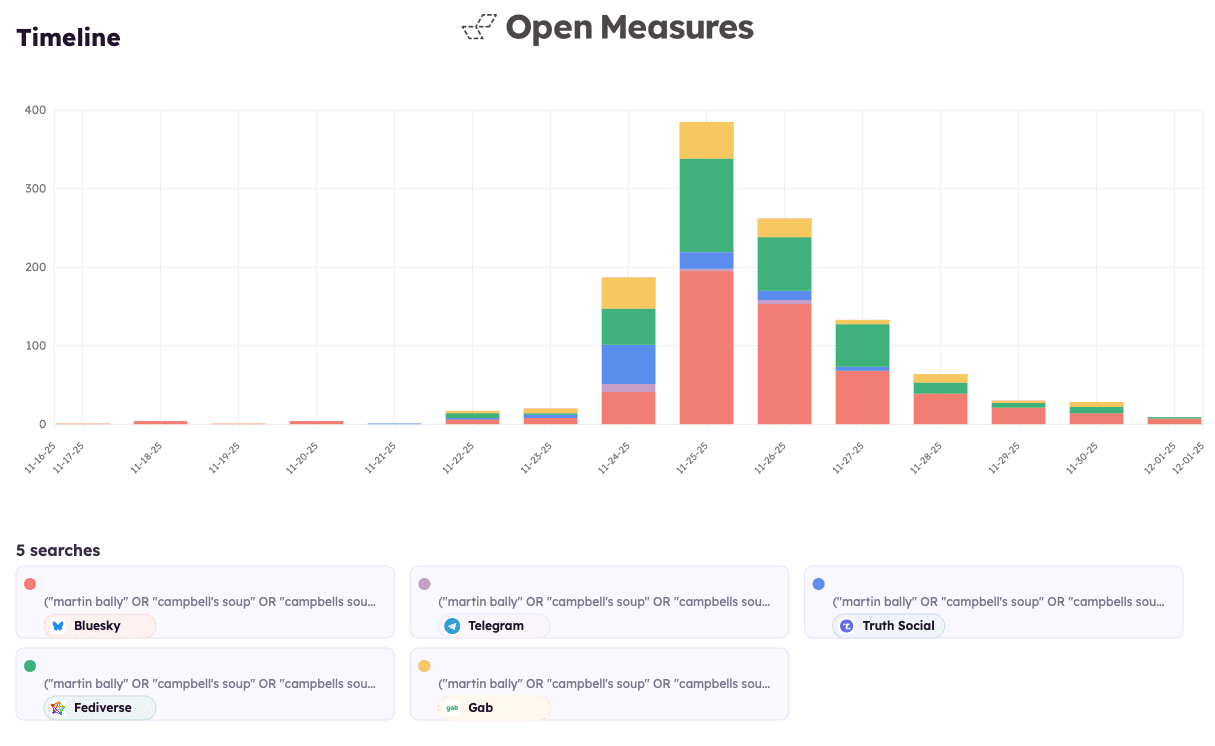
News reports covering Bally’s alleged remarks drove a surge in mentions of Campbell’s that coincided with Thanksgiving Day in the United States. Conversation about Campbell’s was minimal across the platforms we examined prior to media coverage of the lawsuit.
In the two-week period we analyzed, Campbell’s and Bally were mentioned in 1,168 posts across the five platforms we reviewed. More than 90% of the posts identified appeared during the week of Thanksgiving, and nearly half of them appeared on Bluesky.
Prominent Narrative Themes
Across the platforms we examined, our researchers observed users questioning the quality of Campbell’s products, expressing outrage over Bally’s alleged comments, and proclaiming that they would abstain from buying food from Campbell’s. Of the posts our researchers identified:
About 40% included keywords related to the executive’s alleged remarks about “poor people”
About 34% included keywords related to product quality
About 14% included keywords related to racism
About 8% included keywords related to negative consumer actions
Posts about Campbell’s alleged use of “bioengineered meat” seemed to earn more engagement than posts discussing other alleged comments attributed to Bally.
Bally as Whistleblower
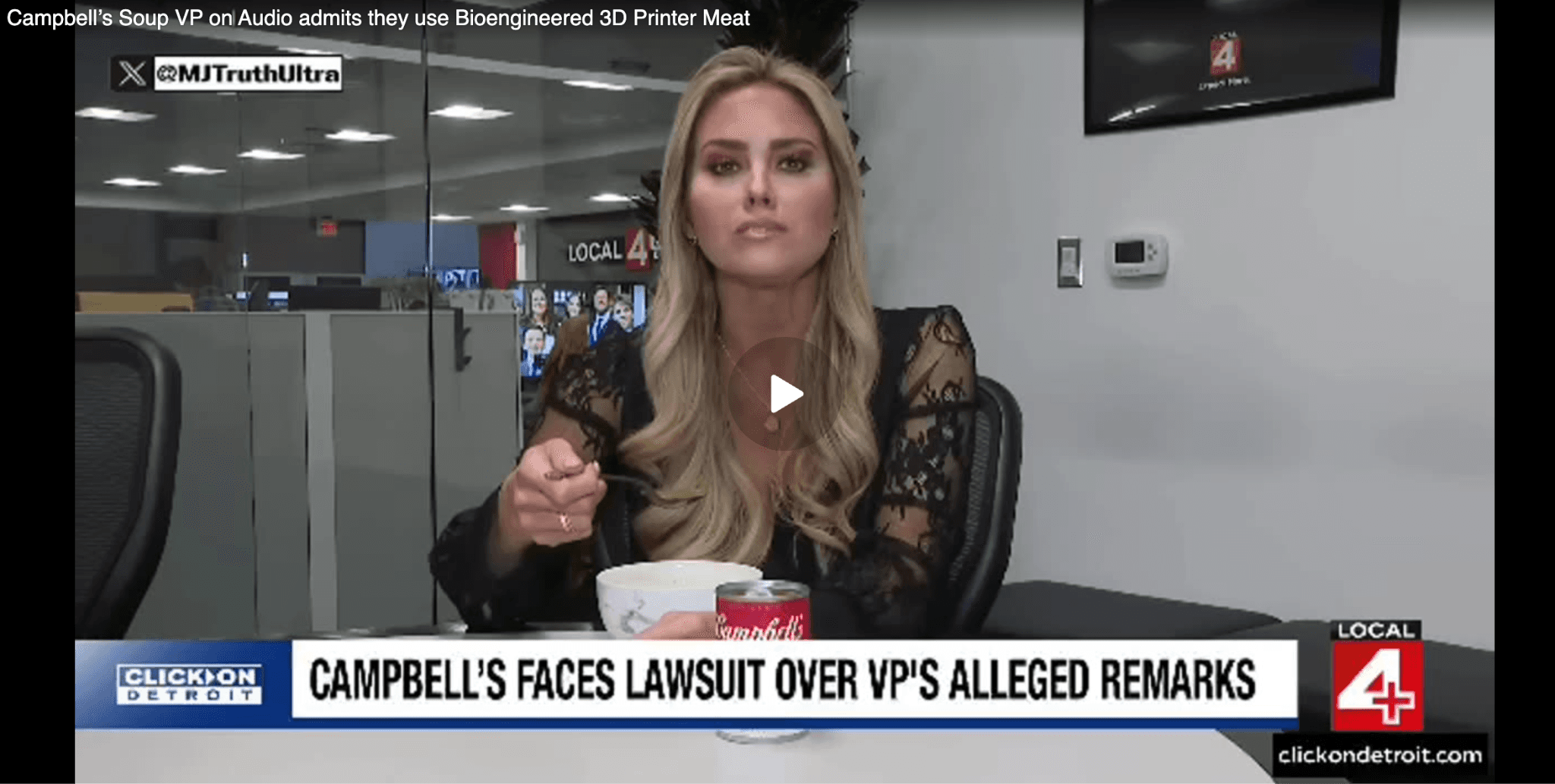
Researchers observed that several posts framing Bally as a whistleblower received hundreds of shares from other users on platforms where they appeared. For example, a set of Telegram posts shared by a QAnon conspiracy theorist were reposted nearly 1,000 times each. The posts included a clip from a local news segment covering the lawsuit that had been posted on Rumble, with a headline that inaccurately represented the segment’s coverage.
Frequent Linking to Gateway Pundit
Researchers also found that on platforms we analyzed with more predominantly right-wing communities — Gab, Telegram, and Truth Social — the URL that appeared most often in posts about Campbell’s was a link to an article published by Gateway Pundit, a hyper-partisan news blog known for promoting conspiracy theories, proclaiming that Bally had “exposed” Campbell’s use of bioengineered meat.2
Posts Disparaging Campbell’s Products
Beyond these claims, posts disparaging the quality of Campbell’s products were observed across all platforms as well, with some users proclaiming that they would refrain from purchasing Campbell’s products in the future.
From Truth Social on Nov. 24 [sic]:
DO NOT BY CAMPBELLS SOUP!!!Campbells Soup appears to be lying to consumers by claiming it is using meat when it is actually using bioengineered fake cancer meat! [...] My recommendation - even if you are a “poor person” don’t feed your kids poisonous cancer meat from Campbells Soups.
From Bluesky on Dec. 1 [sic]:
I just saw a video on Reddit of shelves stocked full of untouched cans of Campbell’s soup on clearance for $0.25 a can. I mean, I personally won’t be touching the shit ever again myself. Truth or not LOL. Soylent green baby. Not taking chances.
Other users cited the former executive’s alleged comments about customers as a reason not to purchase Campbell’s food products — from Bluesky on Nov. 25 [sic]:
campbells soup isn’t for eating, it’s for throwing at billionaires’ heads
From Bluesky on Nov. 28 [sic]:
Campbell’s Soup insults the poor, disabled and POC: lets all not give them out money since they don’t like us! #News
Conclusion
On all platforms we analyzed, the outraged discussion about Campbell’s centered almost entirely on the alleged comments related to last month’s wrongful termination lawsuit.
While most of the commentary disparaged both the former Campbell’s executive and the company in harsh terms, online conspiracy theorists notably championed the former executive for exposing Campbell’s supposed use of subpar ingredients. In both cases, various users said they would no longer purchase the company’s products.
Open Measures’ platform provides unique tools for contextualizing shifts in public opinion, which can provide useful information for entities tasked with responding to these shifts. Concerning the online outrage surrounding Campbell’s and Bally, our findings show that a former executive’s alleged comments may have drastically damaged a company’s reputation — damages that may persist even after the company’s attempts to correct the record and clear confusion..
Identify disinformation and extremism with the Open Measures platform.
Organizations use Open Measures’ tooling every day to track trends related to networks of influence, coordinated harassment campaigns, and state-backed info ops.