


TLDR
Republican lawmakers have sought to pass federal election laws ahead of 2026 US midterm elections that critics say would disenfranchise millions of eligible voters. One such bill, the SAVE America Act, passed the US House of Representatives earlier this month but faces roadblocks in the US Senate.
Open Measures found that discussions of the SAVE America Act steadily increased across seven platforms with dominant pro-Trump communities in the US throughout January, then spiked after a federal judge blocked Trump from changing election laws via executive order.
Researchers saw that pro-Trump communities have attributed blame for the SAVE America Act’s delays in the US Senate to Republican leaders, disparaging them as disloyal and calling for their removal from Congress.
Background
Republicans in US Congress have renewed legislative efforts to restrict voting access ahead of 2026 midterm elections, centering their latest push around a revamped version of the Safeguard American Voter Eligibility Act (“SAVE Act”).1 The current iteration bill, known as the SAVE America Act, would require individuals to present documentary proof of US citizenship when registering to vote in federal elections, compel states to provide voter registration data to the Department of Homeland Security, and allow for criminal charges against state election officials who fail to comply.2
Lawmakers supporting the SAVE Act claim its demands are necessary to prevent non-citizens from voting in US federal elections, an exceedingly rare occurrence that is already illegal.3 Its opponents, including many legal experts and civil rights advocates, have warned the bill would effectively disenfranchise millions of eligible voters, disproportionately affecting younger voters and people of color.4
Lawmakers narrowly passed the SAVE Act in the US House of Representatives on Feb. 11, but the bill faces roadblocks in the US Senate: It currently lacks the necessary legislative support it would need to defeat a filibuster from its opponents, who under current procedural rules could indefinitely delay and block a vote to pass the bill.5 President Donald Trump has encouraged Senate Republicans to find a way to overcome this hurdle before midterm elections, claiming Republicans will “never lose a race” if the SAVE Act’s proposed restrictions are enacted.6
A handful of Republican leaders in the Senate have so far stalled voting on the SAVE Act, drawing ire from Trump’s online supporters. Senate Majority Leader John Thune promised a vote on the SAVE Act but has shown reluctance to support proposed tactics for defeating a filibuster.7 Sen. Mitch McConnell of Kentucky, who heads the Senate Rules Committee, has so far declined to schedule a vote on the bill.8
Methodology
Open Measures’ researchers searched for posts that mentioned the SAVE Act between Jan. 1 and Feb. 24, 2026, on seven platforms harboring dominant pro-Trump communities in the US: 4chan, Gab, Gettr, Rumble, Scored, Telegram, and Truth Social. They used the following search string to identify posts for their analysis:
“save act” OR “save america act”Our researchers then used features available through our platform to analyze trends and highlight notable actors in the information surfaced by their query.
Analysis
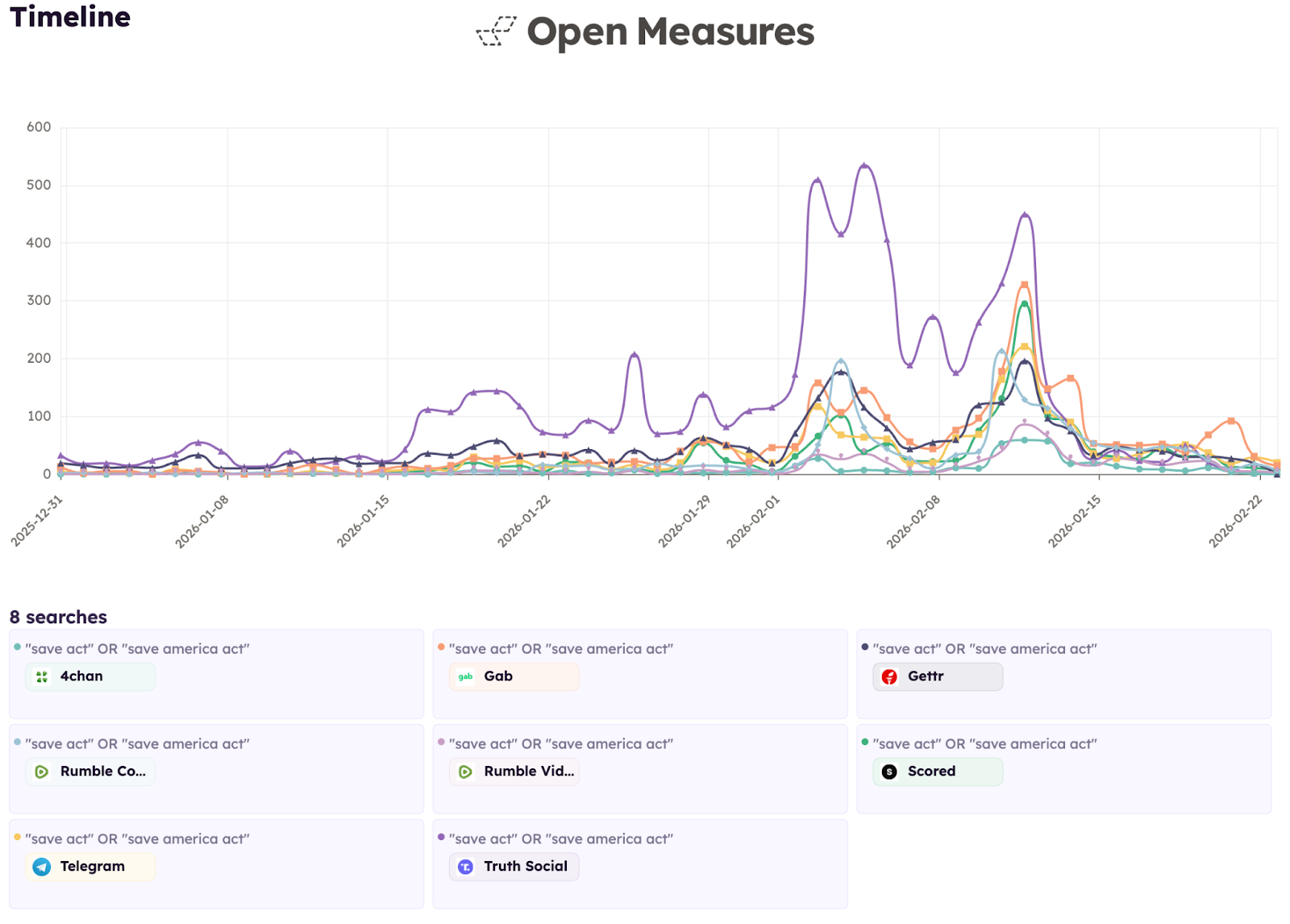
The search string above identified more than 17,000 posts that mentioned the SAVE Act across the seven platforms included for analysis. Using the Timeline feature, our researchers visualized the number of posts per day that matched their query on each platform, allowing them to observe interest in the bill over time.
Mentions of the SAVE Act gradually increased throughout January, as Republican lawmakers and media personalities geared up for their latest attempts to pass voter ID laws. The first major spike came in early February, after a federal judge blocked a 2025 executive order in which Trump sought to require voters to show documentary proof of citizenship before casting ballots, ruling that presidents didn’t have authority to dictate rules for elections.9 Another spike followed in mid-February, after House Republicans passed the SAVE Act.
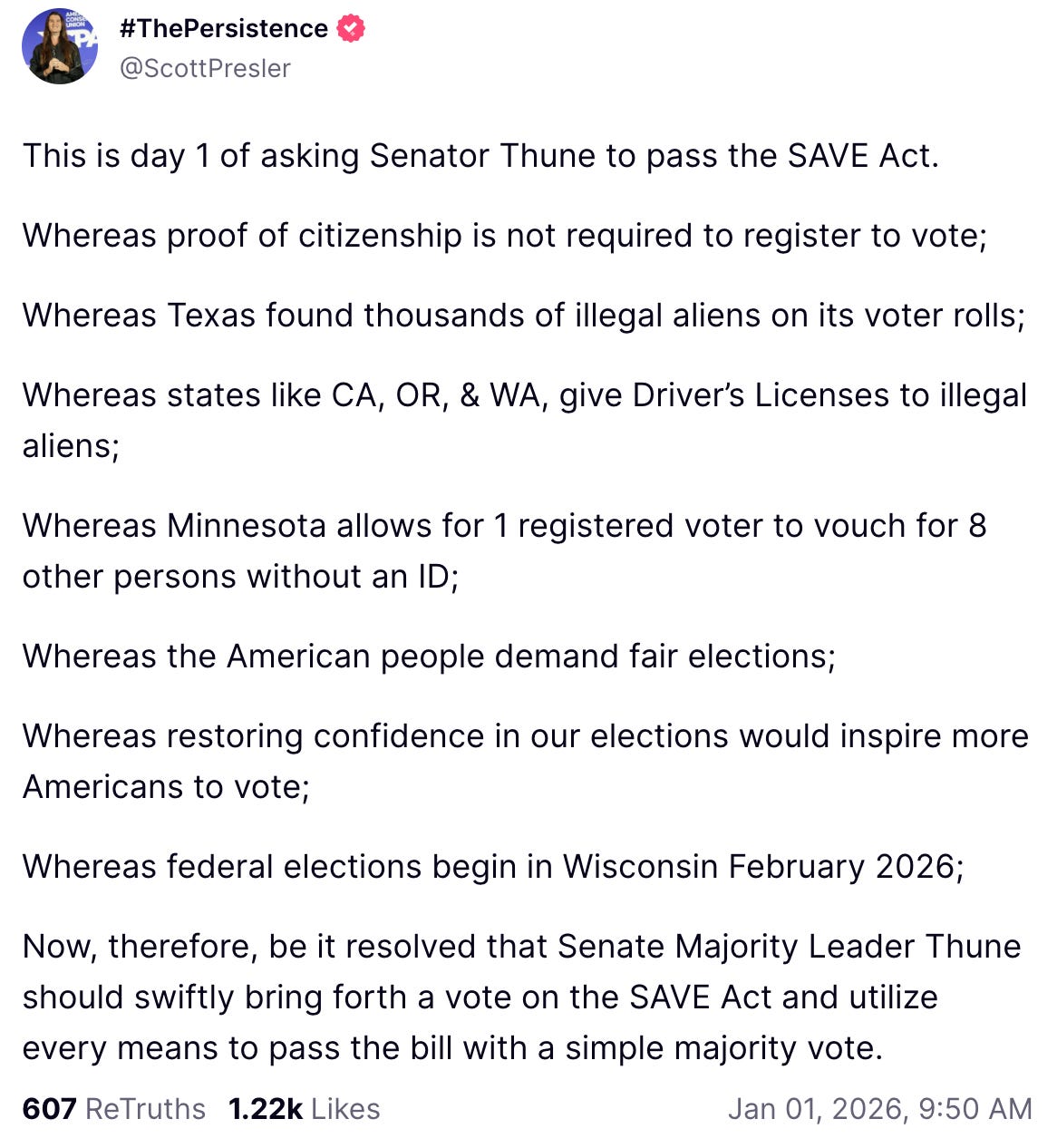
Researchers filtered the results of their search to show posts that had been re-shared 250 or more times on their respective platforms. Next, they used “Discover” to manually review those posts. Many of the most-shared posts in January originated from Scott Pressler, a Republican activist and social media personality who has spent years promoting conspiracy theories about elections and lobbying officials for tighter voting laws.10 Pressler’s posts on Truth Social promoting the SAVE Act accounted for nearly a quarter (23.4%) of all posts we found that received 250 or more re-shares in the analysis period.
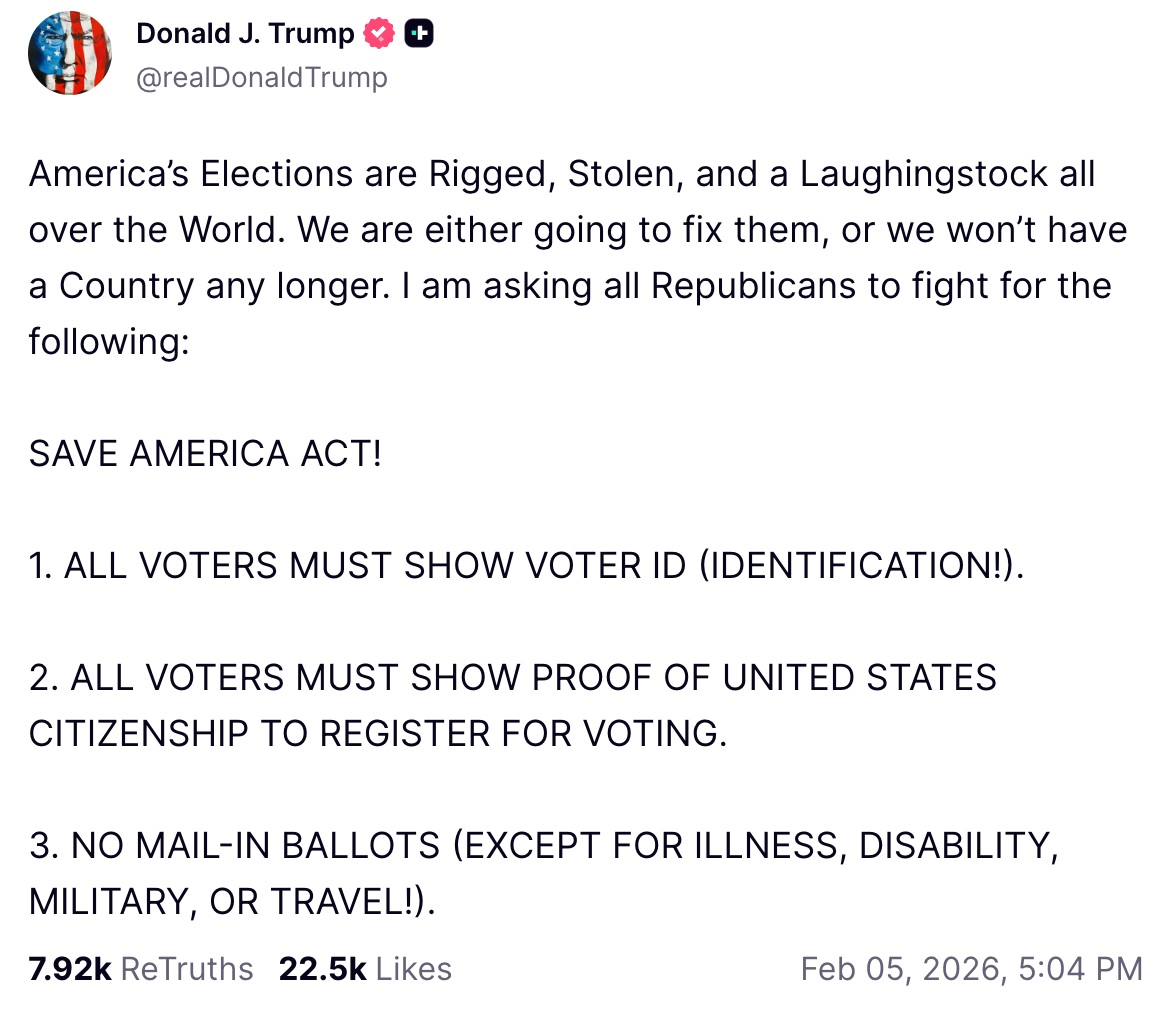
After a federal judge shot down his executive order seeking to mandate voter ID, Trump made several posts on Truth Social calling on Republicans in Congress to pass the SAVE Act before midterm elections. Our researchers have repeatedly observed that Trump’s posts on Truth Social spark increased interest in the topics they mention, with users across an array of platforms aggregating and opining on his messages.
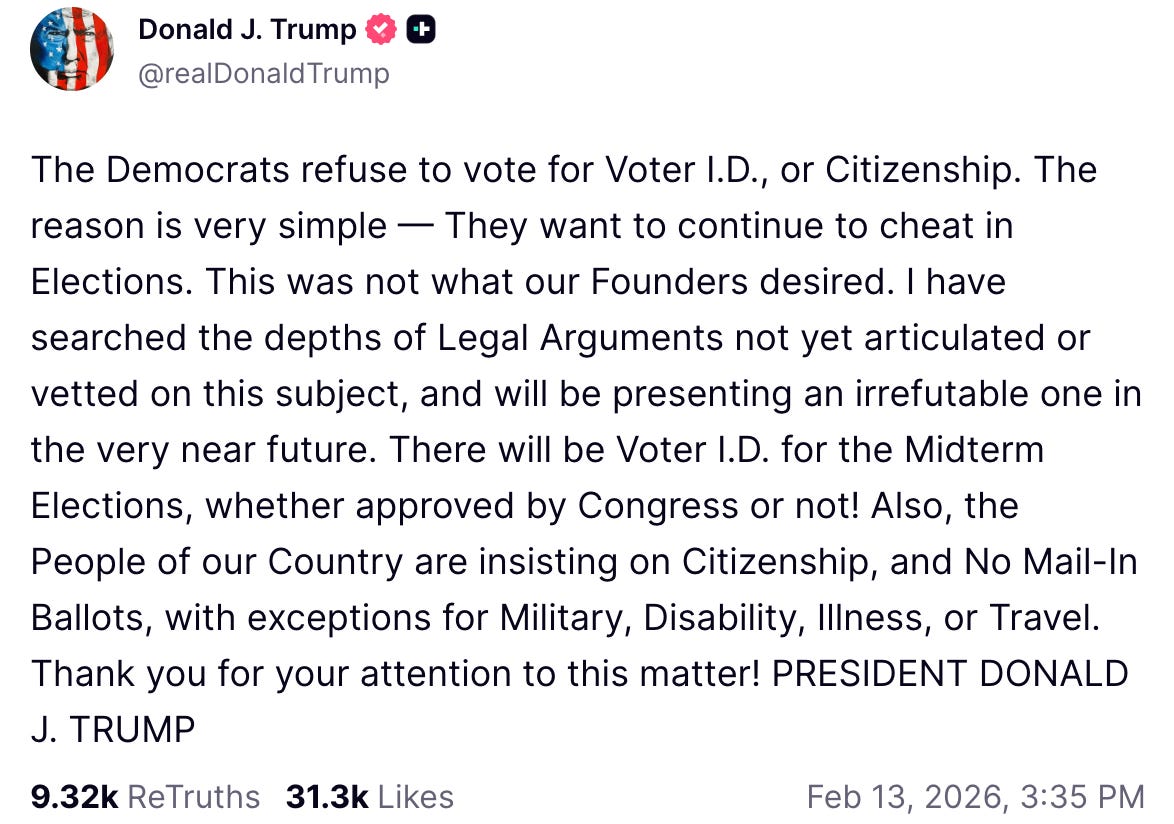
On Feb. 13, as the bill began to stall in the Senate, Trump posted that he was working on a new executive order that would ensure voter ID requirements were in place for midterm elections, “whether approved by Congress or not!”11 Mentions of the SAVE Act across platforms dwindled after Trump posted that message.
Trump Supporters Attack Mitch McConnell
At the time of writing, the SAVE Act has passed the House but lacks the necessary support in the Senate to overcome a filibuster from its opponents. Trump and his hardline supporters have repeatedly encouraged Senate Republicans to repeal the filibuster, but legislative leaders have so far dismissed the idea. Some Trump allies have floated potential strategies for defeating an attempted filibuster as well, but Republican Senate leaders have similarly shown hesitancy to try the proposed tactics.12
Trump supporters online, frustrated by the roadblocks preventing a quick passage of the SAVE Act, have turned their ire toward top Senate Republicans, faulting them for not forcing a vote and for brushing off ideas for out-maneuvering its legislative opponents. Our researchers observed that users have most often blamed McConnell, who has refused to schedule a vote on the bill, and to a lesser extent Thune, the top Senate Republican, for the SAVE Act’s hangups.
Users on the platforms we analyzed attacked McConnell, accusing him of being corrupt and senile, and called for his removal from the Senate.
A Feb. 22 post on Telegram read:
Frankly, he needs to go die. There is no reason to block the SAVE Act whatsoever
A Feb. 20 post on Gettr read:
This is the man BLOCKING the SAVE ACT.. Mitch McConnell needs to be REMOVED for being mentally incompetent.
A Feb. 18 post on Telegram read:
Mitch McConnell is a no vote on the SAVE ACT. Over 90% of his constituents would vote yes. But his owners don’t want it. He barely walks. Has no clue where he is. Everything wrong with politics. Congress was not meant to be a crooked nursing home.
Researchers also observed posts suggesting that McConnell’s staffers were responsible for the blockage of the SAVE Act. A handful of users blamed Terry Carmack, who serves as McConnell’s chief of staff.
A Feb. 22 post on Scored read:
Terry Carmack is blocking the SAVE ACT… so, what’s his deal? He a deep state pedo, money launderer, a retarded commie, or what?
A Feb. 20 post on Gab read:
We all know his staff are the ones blocking the SAVE act. Glitch McConnell is just as senile as Biden.
Conclusion
Pro-Trump online communities have spent years promoting conspiracy theories that question the legitimacy of elections, including assertions that Democrats are padding vote counts with illegitimate ballots from non-citizens (who are not legally allowed to vote).13 The SAVE Act is an apparent attempt to validate and capitalize on these theories, seeking to restrict ballot access under the auspices of preventing non-citizens from voting.
Online efforts to bolster support for voter ID laws and pressure Republican lawmakers to pass them could result in the disenfranchisement of millions of eligible American voters. Inversely, failed attempts to pass or implement such laws could provide fresh fodder for narratives that attack the legitimacy of midterm election results, which have for years inspired violence and threats against government officials.14
With Open Measures’ platform, we will continue to monitor both communities that traffic election misinformation as well as any organized responses to it.
Identify online harms with the Open Measures platform.
Organizations use Open Measures every day to track trends related to networks of influence, coordinated harassment campaigns, and state- backed info ops. Click here to book a demo.
Benjamin Swasey. “A Republican plan to overhaul voting is back. Here’s what’s new in the bill.” NPR. 19 February 2026. Here.
Wren Orey, Matthew Weil, and Julianne Lempert. “Five Things to Know About the SAVE America Act.” Bipartisan Policy Center. 2 February 2026. Here.
Eliza Sweren-Becker and Owen Bacskai. “New SAVE Act Bills Would Still Block Millions of Americans From Voting.” Brennan Center for Justice. 2 February 2026. Here.
Sahil Kapur. “Trump’s election bill tops 50 Senate votes, but Democrats could still block it.” NBC News. 17 February 2026. Here.
Jacob Knutson. “Trump says Republicans will ‘never lose a race’ if Congress restricts voting.” Democracy Docket. 19 February 2026. Here.
Carl Hulse. “Senate G.O.P. Faces Pressure to Force ‘Talking Filibuster’ for Voter ID Bill.” The New York Times. 21 February 2026. Here.
Hafiz Rashid. “McConnell Stalls Trump’s Election Overhaul Bill as Republicans Fume.” The New Republic. 20 February 2026. Here.
Ryan Knappenberger. “Federal judge blocks Trump’s new voter registration requirements.” Courthouse News Service. 30 January 2026. Here.
Matt Dixon. “Scott Presler, a conservative activist who has spread conspiracy theories, won’t be getting an RNC job.” NBC News. 19 March 2024. Here.
Justin Papp. “Trump says he will issue executive order to get voter-ID requirements before midterms.” CNBC. 13 February 2026. Here.
Jordain Carney. “Filibuster fight comes full circle as GOP faces internal pressure on elections bill.” Politico. 10 February 2026. Here.